
"Large" and "modern" are not often associated with Patek Philippe, yet this does not mean the brand stops striving for new forms and approaches.

At the Watches & Wonders 2026 exhibition, the company unveiled the new Patek Philippe Celestial Sunrise and Sunset Ref. 6105G-001 - a larger and more modern interpretation of its Celestial astronomical watches. We took a closer look at this novelty to understand how it feels on the wrist and how successfully the new concept is implemented in practice.
New Generation Celestial: Combining Tradition and Innovation
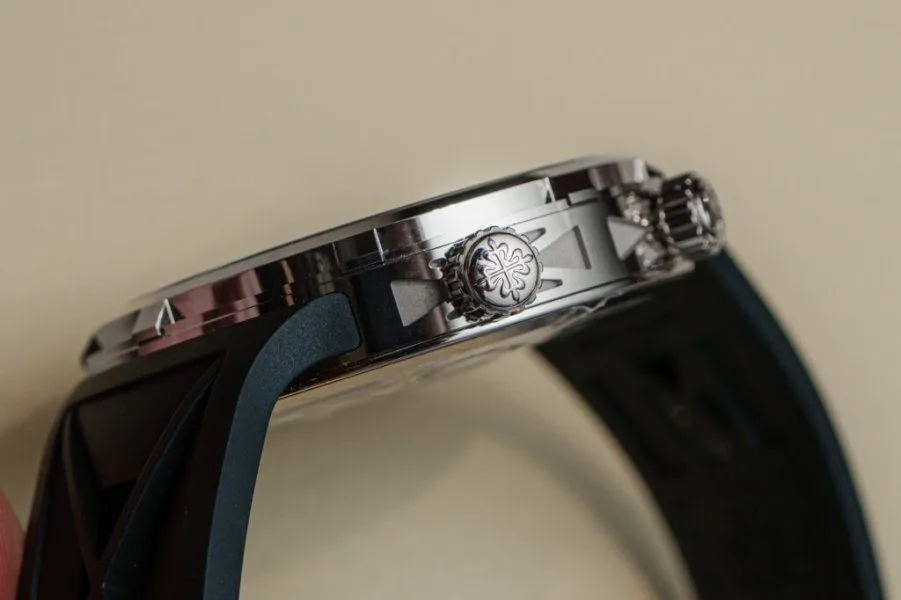
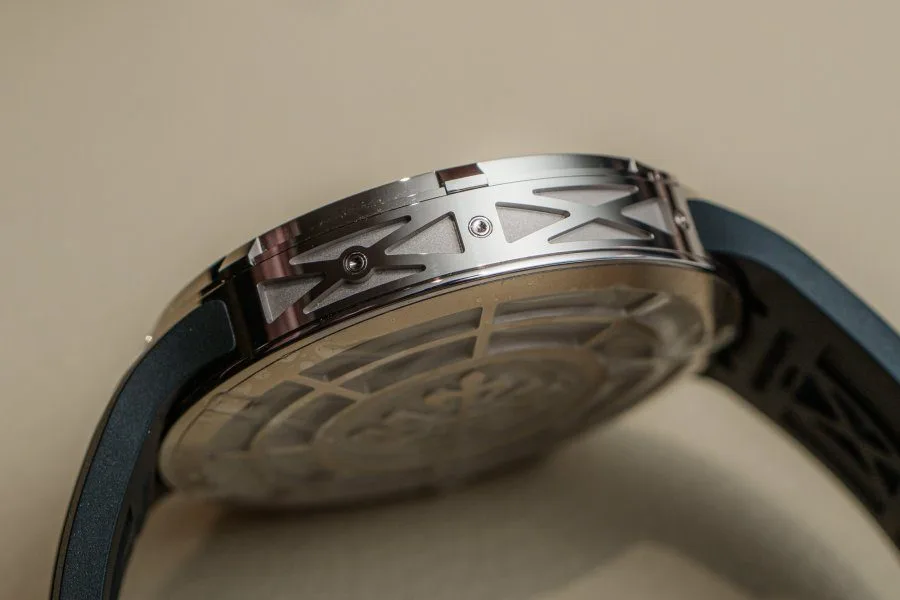
Ref. 6105G-001 replaces the recently discontinued Ref. 6102. The new model adds to the already complex astronomical layout with a sunrise and sunset time display function. The case is made of white gold with a diameter of 47 mm, without protruding lugs, and the strap is integrated with rubber. The unique cross-hatch pattern on the case and case back is inspired by the structural design of space modules. This design is unexpected for Patek Philippe, but in the era of a new space race, where billionaires compete for orbit, it is a logical step.

Comfort and Ergonomics in Practice
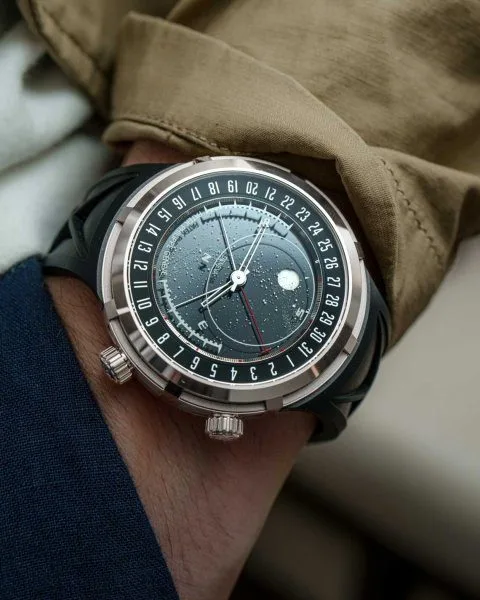
On a wrist with a diameter of 16.5 cm (6.6 inches), the 6105G feels quite manageable despite the impressive case size. The absence of traditional lugs and the integrated strap allow the watch to sit true to its stated dimensions, rather than appearing larger. A thickness of 12.39 mm prevents the watch from slipping unnoticed under a shirt cuff, but overall it feels comfortable. The rubber strap adheres well to the wrist, reducing the sense of bulkiness. The bezel with notches resembles design elements of other models from the "Holy Trinity" of Swiss watchmaking.
Dial: Complex but Logical Structure
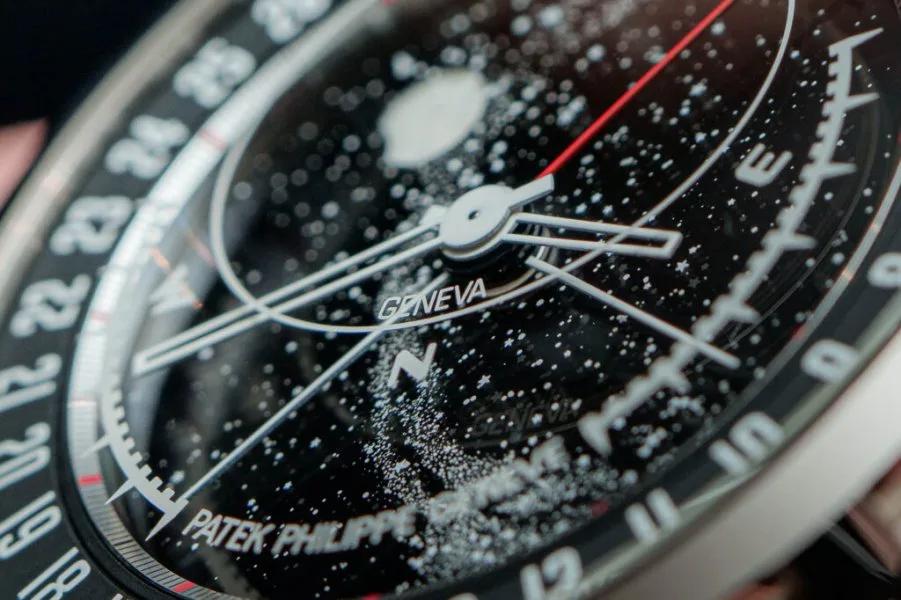
The dial seems saturated and overloaded with information, but upon closer inspection, its methodical nature becomes clear. At the center is the familiar Celestial astronomical display, showing the night sky as seen from Geneva or any other city with similar latitude in the Northern Hemisphere. Several rotating discs display the movement of the stars, as well as the position and phases of the Moon.

Innovations in Sunrise and Sunset Display
A scale is located around the periphery of the dial, serving not only to indicate the date with a red hammer-shaped hand but also simultaneously displaying sunrise and sunset times. Two separate hands are provided for this: sunrise on the right, sunset on the left. As a result, the number "1" on the date scale is not at the usual "12 o'clock" position but is offset to balance the two scales on the dial.
Astronomical Display: Combining Aesthetics and Technique
The celestial map is crafted on a transparent sapphire disc with stars applied, and the Milky Way is printed beneath it, creating a depth effect. An ellipse applied to the inner side of the sapphire glass indicates the visible part of the sky from the observer's point in Geneva. As the disc rotates, the user sees the real position of the night sky from this latitude in real-time. This indication is not practical in the usual sense but is visually impressive, mechanically complex, and poetic in its concept.
Unique System for Daylight Saving Time Transition
One of the key innovations is the patented Patek Philippe system for adjusting the time for the transition from summer to winter time and back - traditionally a complex task for watches with sunrise and sunset functions. On the case at the "9" and "10 o'clock" positions are two adjusting mechanisms, allowing the time to be shifted forward or backward by an hour, synchronizing the sunrise and sunset indication. The watch is equipped with two crowns: at "4 o'clock" for winding and setting the time, at "2 o'clock" for managing astronomical functions.
Movement: Thin and Functional
At the heart of the model is the new caliber 240 C LU CL LCSO - an evolution of the famous ultra-thin Patek Philippe 240 caliber. Despite the added modules for sunrise and sunset display, the movement remains relatively compact with a thickness of 7.93 mm. The frequency is 3 Hz, with a power reserve of 38 to 48 hours. Winding is performed using an off-center micro-rotor made of 22-carat gold.
Case and Case Back: Design and Proportions
The choice of a solid case back, instead of a transparent one, may seem unusual but is explained by the size ratio. The diameter of the movement is 38 mm with the additional modules, while the case reaches 47 mm. A transparent back would highlight the significant difference in sizes. Instead, the X-shaped pattern from the case continues on the back, with the Calatrava cross in the center. Visually, it resembles a medallion-paperweight previously supplied with some Speedmaster models, but an open back could unfavorably reduce the perception of the movement.

Conclusion: A Unique Blend of Tradition and Experiments
The Patek Philippe 6105G is an unusual combination of classic astronomical complication and modern design experimentation. This model is not for the general public but for collectors who already own a significant collection of watches. The Celestial Sunrise and Sunset Ref. 6105G-001 is not the first, second, or even third purchase for most, but an exclusive element of a large collection. Furthermore, a price of $437,610 USD makes it inaccessible to most of Earth's inhabitants.