
Presenting the high-class watch with a triple-axis tourbillon from Girard-Perregaux - the Planetarium Tri-Axial model, reference 99290-52-451-BA4A in an 18-carat rose gold case.
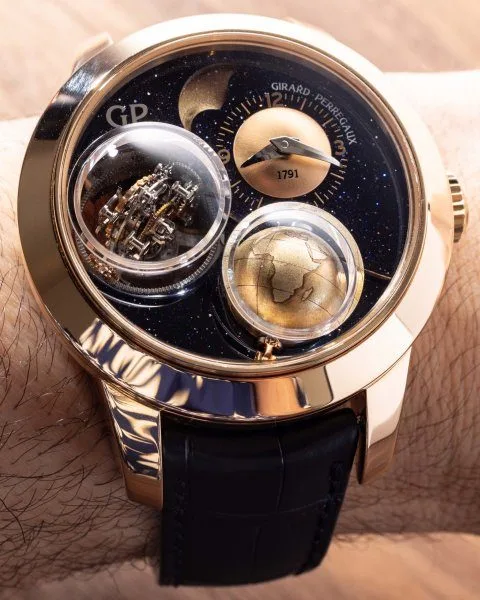
This is a unique, luxurious, and highly unusual piece of horological art. Triple-axis tourbillons (mechanisms that rotate not only around one horizontal axis but also two additional ones, creating a three-dimensional rotation effect) are gaining popularity, and in the coming years, we will see more of them. Although such systems are not new, they are experiencing a kind of renaissance as many manufacturers target the wealthiest buyers. Company executives believe that the richest clients are least affected by economic crises, and they are the target audience for new models.
Triple-Axis Tourbillons: Exclusivity and Complexity
Triple-axis tourbillons, especially when combined with other complications, as in the Planetarium Tri-Axial model, represent a more exotic and complex version of the classic tourbillon, which today can be purchased for just a few thousand dollars. Previously, a tourbillon was a hallmark of ultra-luxury: watches with it cost over $100,000 and indicated the high status of the owner.
Over time, tourbillons became more accessible and democratic, losing some of their status significance, as quality mechanisms can be produced much cheaper. This is why more complex forms of tourbillons restore the exclusivity and status of the complication. Each additional axis of rotation increases the complexity and, accordingly, the value of the watch. Triple-axis tourbillons remain rare and have no cheap analogs on the market. Chinese brands, such as Fam Al Hut, are just beginning to master double-axis tourbillons, but their products are still expensive by the standards of Chinese mechanical watches.
History and Development of Triple-Axis Tourbillons
About 20 years ago, Jaeger-LeCoultre with the Gyrotourbillon series, developed by Eric Coudray, popularized three-dimensional versions of the tourbillon, invented by Abraham-Louis Breguet about 250 years ago. Triple-axis tourbillons are fully mechanical devices based on classical principles but are a modern horological achievement.

Their creation requires high precision and engineering solutions, made possible only through computer modeling, modern manufacturing methods, and new materials. The most critical factors are the mass of the parts and the friction in the adjustment system. Independent master Thomas Prescher may have been one of the first to create triple-axis tourbillons with a focus on elegance. However, his designs differ from the Girard-Perregaux mechanism with caliber GP09310-0002 (GP 9310). Even among triple tourbillons, there are many variations in the workings of the mechanisms.
Features of the Girard-Perregaux Triple Tourbillon in the Planetarium Tri-Axial Model
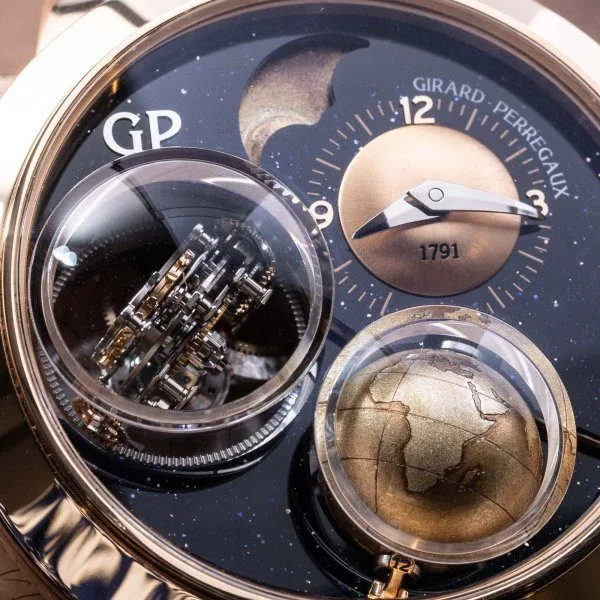
Girard-Perregaux's approach to the triple-axis tourbillon in this model (not the only one with such a complication in their collection) emphasizes visual animation, visibility, and reliability. The mechanism does not aim to be thin or graceful. Moreover, apart from the tourbillon, the movement is not overly complicated. The name "Planetarium" is misleading, as besides the moon phase and day/night indicators (caliber GP09310-0002), the mechanism does not display moving bodies of the solar system - something usually associated with a planetarium. The manual mechanism consists of 388 parts, operates at a frequency of 3 Hz, and has a power reserve of 64 hours. The time is displayed on an additional dial, and the day/night indicator is made in the form of a three-dimensional image of the Earth.

Dial Design and Materials
The globe on the dial is made of titanium and hand-painted. It is an artistic and attractive element that, in my opinion, gives the watch a masculine feel. The dial design features elements of the previous generation of Girard-Perregaux, particularly the style of the hands and hour markers, reminiscent of the 1945 collection with rectangular cases - a style that deserves a revival. The Planetarium Tri-Axial is a massive watch with pronounced case bulges. For conservative watch enthusiasts, its dimensions might seem excessive: the case diameter is 48 mm, and the thickness is 18.82 mm. The case is made of 18-carat rose gold, with water resistance of 30 meters, and features complex-shaped sapphire glass on both sides. There is also a white gold version (reference 99290-53-653-BA6A), which costs €36,000 more, raising questions.

Ergonomics and Wearing the Watch
Despite its impressive dimensions, the Girard-Perregaux Planetarium Tri-Axial does not seem uncomfortable to wear. The watch is wide and fits snugly on the wrist. It may not sit as naturally as a Panerai, but it is securely and neatly fastened on a blue alligator strap. Convex dials are rarely aesthetic but have their advantages: they allow thick watches to appear relatively thinner and provide an excellent view of moving parts such as the tourbillon. In the design of the Girard-Perregaux triple tourbillon, a large horizontal rotating cage surrounds an inner cage rotating on a vertical axis - it is this that creates the effect of three-dimensional rotation. Inside is another rotating point on its own axis.
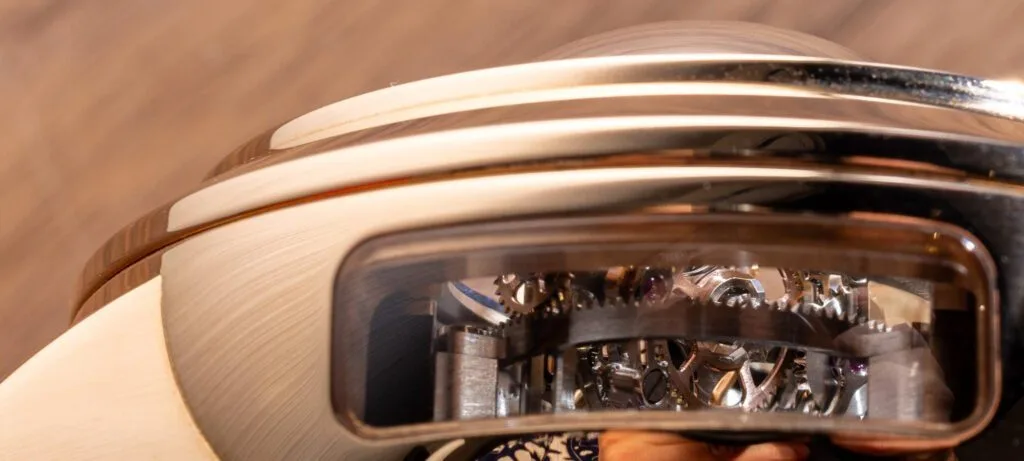
From a chronometry standpoint (the primary task of the tourbillon), the inner axis may not be as important, but in terms of mechanical acrobatics, it is what adds uniqueness and affects the price. The mechanism architecture is executed in the signature style of Girard-Perregaux, and the wide bridge construction of the inner tourbillon ensures reliability and stability.
Conclusion: Mechanical Art and Swiss Precision
The Girard-Perregaux Planetarium Tri-Axial is not a mass fashion product but an expressive piece of mechanical art and high Swiss craftsmanship. The brand demonstrates its versatility and competence through such complex models. These watches are produced rarely and are not often seen, adding to their exclusivity. Despite some design oddities, the quality of execution is high. The blue aventurine dial and sophisticated surfaces emphasize the classic style of the model. One can imagine that the same mechanism could form the basis of a futuristic design in the hands of another company.

Diversity and Experiments of the Girard-Perregaux Brand
One of the main advantages of Girard-Perregaux is the wide range of models and mechanisms produced. The company tends towards classic aesthetics but is not afraid to experiment and introduce playful elements into the design. The decision on the place of the Planetarium Tri-Axial in the world of watches is left to the buyer. The model's price is €381,000.
Technical Specifications Table of Girard-Perregaux Planetarium Tri-Axial
| Specification | Value |
|---|---|
| Reference | 99290-52-451-BA4A |
| Case | 18-carat rose gold |
| Case Diameter | 48 mm |
| Case Thickness | 18.82 mm |
| Water Resistance | 30 meters |
| Movement | Manual, caliber GP09310-0002 |
| Balance Frequency | 3 Hz (21,600 vibrations/hour) |
| Power Reserve | 64 hours |
| Number of Parts | 388 |
| Complications | Triple-axis tourbillon, moon phase indicator, day/night indicator (three-dimensional Earth image) |
| Strap | Blue alligator |
| Price | €381,000 |
This review highlights the uniqueness and complexity of the model, emphasizing its place in the world of high-end watches with a triple-axis tourbillon.